
Yes, the Patriot Power Sidekick is a real product sold on 4patriots.com by 4Patriots, LLC, and it suits short outages, camping and charging phones and laptops. Its 298 Wh battery and 300 W continuous output run phones, lights, a router and a small fan well, but a mini fridge runs for hours rather than days. The number that decides the fit is the watt-hours your gear needs, and the run-time table below lets you check that in a minute.
Affiliate disclosure: Some links on this page are affiliate links. If you buy through them, this site may earn a commission.
Quick facts, dated November 3, 2026
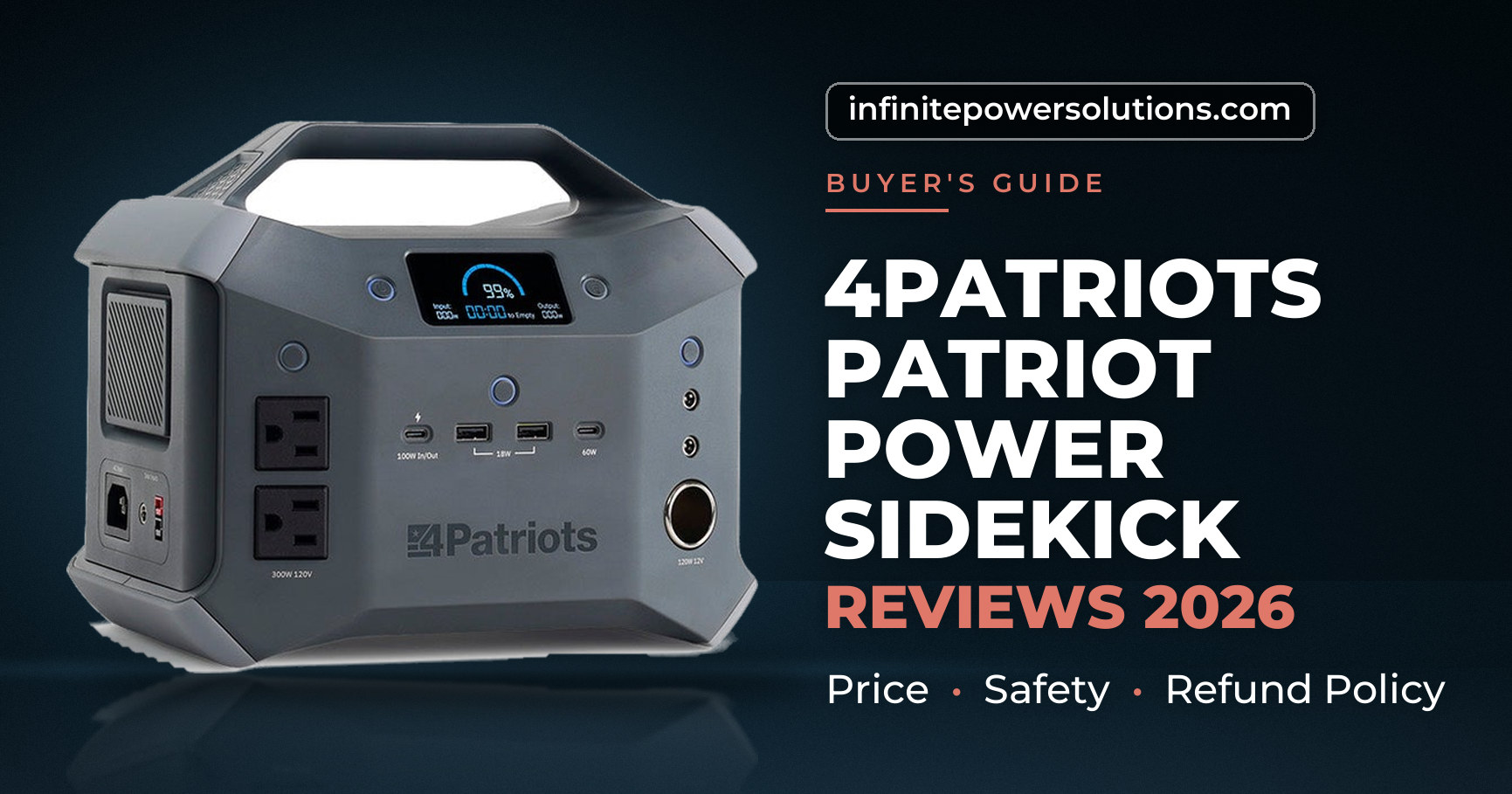
| Fact | Detail |
|---|---|
| Product | Patriot Power Sidekick Solar Generator & Solar Panel |
| Seller | 4Patriots, LLC, selling on 4patriots.com |
| Battery | 298 Wh, lithium-iron-phosphate (LiFePO4), rated by the seller for about 2,000 cycles |
| Output | 300 W continuous, 600 W peak |
| Outlets | 9 in total, including 2 AC |
| Recharge | Wall 1.5 hours; solar 7 hours with the included 40 W panel; 12V car 3.5 hours |
| Weight | 10.5 lbs on the spec list; the comparison panel says “Only 8 Pounds” |
| Price | $499.00 as listed (date in the price section) |
| Guarantee | “100% Satisfaction Guaranteed” and “Try it risk free for 90 days,” per the product page |
| Shipping | Banner: “Free Shipping on Orders Over $149”; listing: “Ships late September from Georgia, USA” |
| Reviews | 4.4 out of 5 from 233 reviews on the seller’s page |
| Stock signal | “Notify Me” button beside the price |
| Product Page | Product Page |
What is the Patriot Power Sidekick, and who is it for?
4Patriots, LLC sells the Sidekick on 4patriots.com. The product page describes a carry-by-handle unit that weighs 10.5 pounds and is built to keep personal devices running when the grid fails. The seller says it is “not a whole-house system.”
The seller pitches four uses:
- Outage backup: a mini fridge, phones and lights, kept on a nightstand or kitchen counter.
- Camping and RV trips: fans, camp lights and phones, with 9 outlets.
- Remote cabin: paired with the 40 W panel, to run a laptop and a Wi-Fi router.
- Worksite: work lights and topping off cordless tool batteries.
It fits best if your loads are phones, lights, a router, a fan or a small fridge. It is a poor fit for heavy power tools, which the seller says it will not run, or for whole-house power.
This is desk research: this site has not tested or used the Sidekick, so the performance figures are the seller’s.
Are the 4Patriots solar generators any good?
The Sidekick averages 4.4 out of 5 from 233 reviews on the seller’s own page. Three reviews show the range:
- 2 stars, January 5, 2025: the reviewer bought the unit in May 2023, kept it boxed, and found it would not charge from an outlet during an outage in January 2025. The reviewer says the seller would not help because it was over a year old.
- 5 stars, January 29, 2024: the reviewer says it works well but wanted a longer cord than the 3-foot cord to the panel. The seller replied on February 2, 2024, that the feedback would be forwarded to other departments.
- April 21, 2021: a buyer says the unit ran small heaters during a 2020 winter storm outage.
The seller’s footer says some reviewers received free product. It also says testimonials “represent exceptional results” and do not apply to the average purchaser. The same footer says a former Navy SEAL featured in its testimonials “has been compensated by 4Patriots.” Give the charging complaint real weight, and read the rest as the seller’s selection.
What are the specs, and what is in the box?
| Spec | Seller’s figure |
|---|---|
| Battery capacity | 298 Wh |
| Battery chemistry | Lithium-iron-phosphate (LiFePO4), rated by the seller for about 2,000 cycles |
| Continuous output | 300 W |
| Peak output | 600 W |
| AC outlets | 2 × AC, pure sine wave |
| USB outlets | 2 × USB-A (QC3.0 18W); 2 × USB-C (one In/Out PD 100W, one Out PD 60W) |
| DC outlets | 1 × 12V/10A DC socket; 2 × barrel 5521 (12V/3A each) |
| Total outlets | 9 |
| Solar panel | 1 × 40 W folding panel, included |
| Weight | 10.5 lbs |
| Display | Real-time battery tracking screen |
| Fumes and noise | Fume-free and described as whisper-quiet |
The box holds the Sidekick, the 40 W folding panel, the AC charging adapter cord and the user manual.
The product page gives two weights. The comparison panel reads “Only 8 Pounds,” and the spec list says 10.5 lbs. Plan around 10.5 lbs and ask 4Patriots which figure is right.
How do you charge it, and can you use it while it charges?
The product page lists three charging routes. Wall power is the fastest. Solar is the route for outages with no grid power, and the seller says it slows on cloudy days.
| Charging route | Seller’s time | Note from the product page |
|---|---|---|
| Wall outlet | 1.5 hours | Fastest route, with the AC charging cord |
| Solar | 7 hours | Connect the 40 W panel and place it in full, direct sun |
| 12V car | 3.5 hours | Charges from the car socket |
The seller calls its pass-through charging a feature: you can power devices while the unit recharges. The seller advises topping it off from a wall outlet or your car before a storm.
How long will it run a fridge, a CPAP and phones?
Divide the battery’s watt-hours by a device’s watts, and you get the hours it would run nonstop before inverter losses. The Sidekick’s battery is 298 Wh.
| Device | Watts listed | Seller’s run time | Arithmetic (298 Wh ÷ watts) |
|---|---|---|---|
| Mini fridge | 80 W | 15 hours, cycling | 298 ÷ 80 = 3.7 hours nonstop |
| Portable fan | 40 W | 7 hours | 298 ÷ 40 = 7.5 hours nonstop |
| Portable fan | 60 W | 4 hours | 298 ÷ 60 = 5.0 hours nonstop |
| Home security device | 15 W | 20 hours | 298 ÷ 15 = 19.9 hours nonstop |
| LED lamp | 10 W | 30 hours | 298 ÷ 10 = 29.8 hours nonstop |
| WiFi router | 15 W | 18 hours | 298 ÷ 15 = 19.9 hours nonstop |
The fridge: a fridge cycles on and off, so its average draw is lower than 80 W. The seller’s 15-hour figure implies an average draw of about 20 W (298 ÷ 15). The seller’s footnote says interior and exterior temperature, appliance age, the contents and how often the door opens all change the result. Keep the doors closed, as the Red Cross advises below.
The CPAP: the seller lists 18 hours for a CPAP, but its footnote says basic estimates are for units without heat or humidity. Check your machine’s wattage and features, and ask your doctor or supplier before relying on it for medical equipment.
Phones: read the watts on your charger and divide 298 by that number.
A 2,000-watt generator? Watts show how much a unit can supply at one moment. Watt-hours set how long it lasts. The 2200X, a larger 4Patriots unit, has 2,240 Wh, so an 80 W fridge would run about 28 hours nonstop (2,240 ÷ 80). Read the 4Patriots 2200X reviews for its full specs.
A 1,000-watt generator? Use the same method with that unit’s watt-hours. A 1,000 Wh battery running an 80 W fridge lasts about 12.5 hours nonstop (1,000 ÷ 80).
How long will food last in the fridge without power in winter?
The Ready.gov power outage fact sheet says a refrigerator keeps food cold for about four hours, and a full freezer stays at a safe temperature for about 48 hours. The Red Cross power outage safety page says an unopened refrigerator keeps food cold for about 4 hours, and a full freezer holds its temperature for about 48 hours (24 hours if half full). It also says to throw out food that has been warmer than 40°F.
In cold weather, Ready.gov says not to store food outside or in the snow. The Ready PA power outage guide is stricter about time: throw away food exposed to 40°F for two hours or more. When in doubt, throw it out.
The Sidekick’s run time for the fridge is longer than the closed-door window, so the four-hour rule is the number to plan a fridge around.
How much do Patriot generators cost, and which gives the most for the money?
Prices as shown on the seller’s product page captured October 28, 2026; check the checkout for today’s.
| Unit | Price shown | Capacity | Outlets | Dollars per Wh (arithmetic) |
|---|---|---|---|---|
| Sidekick & Solar Panel | $499.00 | 298 Wh | 9 | $1.67 (499 ÷ 298) |
| Blackout Buddy Emergency Power Supply | $1,299 | 1,030 Wh | 2 | $1.26 (1,299 ÷ 1,030) |
| Patriot Power Solar Generator 2200X & Solar Panel | $3,199 (shown beside $3,499) | 2,240 Wh | 10 | $1.43 (3,199 ÷ 2,240) |
On the seller’s listed prices, the Blackout Buddy costs the least per watt-hour and the Sidekick costs the most. Cost per watt-hour is only one measure. The Blackout weighs 35 lbs with two outlets, and the Sidekick weighs 10.5 lbs with nine outlets.
The seller’s comparison panel also lists the AlphaCase Elite Solar Generator & Panel at 800 W, 736 Wh and 27.2 lbs. The 4Patriots 1200 is listed on sale at $1,399 against $1,699 regular, and has its own 4Patriots 1200 reviews page on this site.
What does the Sidekick cost in total, including shipping and payment plans?
Your total is the $499.00 listed price plus shipping and tax shown at checkout. The site banner says “Free Shipping on Orders Over $149,” so check the shipping line on your own order.
The product page offers “Easy Payment Plans,” described as “Options designed to fit your budget,” and the footer links to Splitit Payment Plans. Get the monthly amount, the number of payments and any fees in writing before you confirm a plan.
The listing shows a “Notify Me” button beside the price and says the unit “Ships late September from Georgia, USA.” That window had already passed when the page was captured, so ask for the current ship date.
What are the warranty, refund and returns terms?
The product page makes three promises. Near the price it says “100% Satisfaction Guaranteed.” Its product details say “Try it risk free for 90 days.” Its footer says “We stand behind every order,” and it links to Warranty & Returns and User Manuals.
Open the Warranty & Returns link in the footer before you order and read the return steps. Ask what a return costs, who pays return shipping and how long a refund takes. Keep your order confirmation so you can match it to any return request.
Is 4Patriots legit, and how do you check?
The Sidekick is listed on 4patriots.com by 4Patriots, LLC, and the site’s privacy policy names that company. These checks help before you pay:
- Buy from the seller’s own site. The seller’s privacy policy says it does not cover purchases through department stores, specialty stores or independent third-party websites. If the Sidekick is offered somewhere else, check who sells it.
- Check the contact route. The footer has a Contact link, and the product page says 4Patriots offers “USA-Based Customer Support.”
- Read the affiliation note. The footer says the United States Military, including the U.S. Navy SEAL Team, and other organizations named on the site are not affiliated with 4Patriots and have not endorsed the product.
- Look for a lab mark. The NFPA lithium-ion battery lesson plan says a certification stamp from a nationally recognized testing lab, such as UL, ETL or CSA, means the product meets important safety standards. Check the unit, box and manual for one of these marks, and ask 4Patriots which lab tested it.
- Get payment terms in writing. If you use a payment plan, confirm the terms before you confirm the order.
Where are 4 Patriot solar generators made?
The Sidekick ships from Georgia, USA, and the product page says 4Patriots offers USA-based customer support. Ask 4Patriots through the Contact link in the footer where the unit is manufactured, and get the answer in writing.
How does the Sidekick compare with other 4Patriots units and Jackery?
| Option | Key numbers (seller’s figures) | Fits |
|---|---|---|
| Sidekick | 298 Wh, 300 W continuous, 10.5 lbs, $499.00 | Phones, a lamp, a router, short fridge runs, camping and RV use |
| Blackout Buddy | 1,030 Wh, 600 W, 35 lbs, $1,299 | More stored energy, with two outlets and a heavier unit |
| 2200X | 2,240 Wh, 2,200 W, 57.5 lbs, $3,199 (shown beside $3,499) | Ten outlets and longer outages, at a larger budget |
| AlphaCase Elite | 736 Wh, 800 W, 27.2 lbs, 1-hour recharge | The seller’s tagline is “All-in-1 Power in a Briefcase” |
For a different brand, the Jackery Solar Generator 2000 v2 reviews page covers that brand’s specs and price. Compare watt-hours, watts, outlets, weight and price side by side, and the answer follows from your loads. For the older Patriot Power 1500, see the Patriot Power 1500 specs and runtime guide.
Doing without a unit is a real option. The Pennsylvania guide advises charging phones and battery-powered devices in advance and considering a portable charger. The Indiana DHS power outage tips page advises keeping refrigerators and freezers closed.
Does a generator emit carbon monoxide, and how do you use one safely?
Yes, a fuel-burning portable generator does. The CPSC generator carbon monoxide guidance says generator exhaust contains carbon monoxide, a gas you cannot see or smell, and that one generator produces as much CO as hundreds of cars. The seller says the Sidekick produces no fumes or carbon monoxide.
For a fuel generator, the CPSC says to never run one inside a home, garage, basement, crawlspace or shed, and to keep it well away from windows, doors and vents. The CPSC generator safety insert says never to plug a generator into a wall outlet, a practice called backfeeding, because it endangers utility workers. It also says to connect appliances with heavy-duty extension cords rated for outdoor use, and to turn the generator off and let it cool before refueling. The Ready.gov power outage fact sheet says to use generators outdoors and at least 20 feet from building openings.
On running one all night: the same location rules apply for as long as it runs, so only run a fuel generator outdoors. Check its manual for run limits. Install battery-operated CO alarms on every level, since the CPSC says a home should have one near the bedrooms.
Consumer Reports’ advocacy team told the CPSC in 2017 that warning labels alone are not enough to protect consumers. The Consumer Reports comments to CPSC document makes that case.
Is a lithium-ion battery like this safe indoors, and can it catch fire when unplugged?
LiFePO4 is one kind of lithium-ion chemistry. The OSHA lithium-ion battery safety fact sheet lists lithium iron phosphate (LiFePO4) as a cathode material, and says lithium-ion batteries power phones, laptops, tablets, cameras, power tools and electric vehicles. The seller says the battery is “Safe to use inside.”
The main risk is thermal runaway. OSHA describes it as a chain reaction in which heat from one failing cell damages nearby cells. It can start with an internal short circuit, mechanical damage, exposure to excessive heat or cold, or improper charging.
On the unplugged question, the FDNY lithium-ion battery safety tips say uncertified batteries can overheat, catch fire or explode even when they are not charging. Those tips are guidance for e-bikes and e-scooters. They say to charge on the floor, keep charging out of bedrooms, plug the charger directly into a wall outlet, and skip extension cords.
The NFPA lithium-ion battery lesson plan says to charge devices on a hard surface, not under a pillow, on a bed or on a couch. It says to stop using a device that gets too hot, smells strange, makes popping noises or changes shape or color, to move it away from anything that can catch fire if that is safe, and to call 9-1-1.
The 80/20 question: the seller’s FAQ says the battery keeps at least 80% of its capacity through about 2,000 charge cycles. That is the seller’s rating. The product page labels the same figure “5 Years of Dependable Use,” while the FAQ says about six years of daily use. Ask which period applies.
Is it hazmat? OSHA points shipping of lithium batteries to US Department of Transportation rules at 49 CFR 173.185 and to IATA guidance.
What uses lithium-ion batteries? The FDNY tips list cell phones, laptops, tablets, power tools, electric cars and e-bikes or e-scooters. OSHA adds cameras and machinery.
How do you prepare for 72 hours without power?
Ready.gov says to gather supplies to last several days and to keep phones and electronics charged before an outage. The Red Cross says to store food and water for at least two weeks, keep a crank or battery radio, and have chargers for your phones. The Indiana DHS page lists a disaster kit of water, non-perishable food, flashlights for every household member, batteries, a radio and first-aid supplies.
A battery unit like the Sidekick covers the charging and light part of that list. It does not replace water or food.
Can I still shower in a power outage, and what does it cost?
Read the nameplate watts on your electric water heater first. The Sidekick is rated for 300 W continuous, so a heater rated above that is beyond its continuous output.
To estimate the cost, multiply the heater’s kilowatts by the hours it runs, then by your utility’s price per kilowatt-hour from your bill. A 20-minute shower is one-third of an hour, so a 4 kW heater uses 1.33 kWh (4 × 1/3). Multiply that by your rate.
Is it worth buying a portable solar generator?
It is worth it when the things you plug in fit inside the unit’s watt-hours and watts. Ready.gov says to plan which items you will plug in first, since you may not be able to power every appliance at once. Oregon’s emergency management guide, the Oregon winter power outage guide, calls portable power banks, especially solar ones, a backup option.
For a phone and a lamp, a power bank may be enough. For a fridge through a longer outage, the Sidekick’s 298 Wh is the number to test against your own run time.
Who should buy it, and who should skip it?
| Question to ask yourself | If yes | If no |
|---|---|---|
| Do you mainly need phones, lights, a fan or a router during short outages? | The 298 Wh covers the run times in the table above, and the Sidekick is the lightest unit in the comparison at 10.5 lbs. | A larger unit from the comparison table fits better. |
| Do you need a mini fridge through a long outage? | Compare the 15-hour cycling figure with your outage length, and keep the door closed. | Plan a cooler with ice. The Red Cross power outage safety page says to use coolers with ice. |
| Do you need heavy power tools or whole-house power? | Look at a different unit. The seller says the Sidekick is not a whole-house system and will not run heavy power tools. | The Sidekick’s work-light and cordless-battery use may fit. |
| Do you want a quiet, fume-free unit for indoor use? | The seller describes the Sidekick as fume-free and whisper-quiet. | A fuel generator must stay outdoors, as the CPSC guidance above explains. |
| Do you plan to use the home Wi-Fi during an outage? | Read the home Wi-Fi outage backup checklist to see which boxes need power. | The Sidekick still covers a router in the run-time table. |
Before you order: a buyer checklist
Open the Product Page and check these items:
- Ship date: the listing says “Ships late September from Georgia, USA,” and the “Notify Me” button sits beside the price. Ask for the current ship date.
- Total: check the final total, with shipping and tax, at checkout.
- Payment plan: get the monthly amount, number of payments and any fees in writing.
- Weight: confirm whether the unit is 10.5 lbs or 8 lbs.
- Where it is made: ask 4Patriots through the Contact link.
- Expansion: ask whether an extra battery works with the Sidekick and what its maximum solar input is.
- Outage switchover: ask whether the unit switches to battery automatically when grid power fails.
- Panel cord: one reviewer found the 3-foot cord too short. Confirm the length before you plan the panel’s position.
- Battery life: confirm which period the 2,000-cycle rating covers, five years or about six.
- Lab mark: confirm which lab tested the unit, and look for a UL, ETL or CSA mark.
- Returns: read the Warranty & Returns page, including the return cost.
- Banner offer: ask what the “2200X + 2 FREE Panels” banner covers and whether it applies to the Sidekick.
By InfinitePowerSolutions.com Technology Desk